






Interior and exterior confidence
Create Academy has been such a great resource. I'm in the middle of renovating a bungalow with a very large garden and the courses have offered a wealth of inform...
Harvey
Jun 10, 2026
with THE LAND GARDENERS — Award-winning garden designers and cut flower growers on a mission to save our soil.
Lesson 2 of 13

Subscribe to watch
Soil is the bedrock of life, in this lesson you’ll learn why soil is so important and what it is composed of.
The health of our soils and the health of our planet are intertwined. One of the main foundations of all life on Earth, is that we need healthy soils to grow foods and medicines and to provide a habitat for a diverse array of ecosystems.
Healthy soil systems are vital in the fight against climate change too, as soil is capable of drawing down huge volumes of carbon from the atmosphere and storing it in a stable state.
Thriving soil is important for human health as well, and foods grown in soils that are rich in microbial life are more nutrient dense, not to mention tastier. Soils are one of the most complex ecosystems on Earth: in just a teaspoon of soil there is more microlife than there are people on this planet.
Despite its importance, over the past 70 years we have treated our soil systems very badly. It's estimated that we have degraded at least a third of the world's soil, and as a result, we are losing up to 24 billion tonnes of soil per year.
Put simply, without good-quality soil, we cannot sustain life on Earth. It's not all bad news though. If we start to treat our soils better, without using chemicals, we can restore their diverse microbial life, sequester more carbon, and help to fight climate change.
Roughly 480 million years ago, fungi formed a symbiotic relationship with the first simple land plants by acting as a root system. This relationship helped Earth's early plants to extract minerals from rocks.
Around 80 million years later, plants began to cover the world's surface, and soils began to form as bedrocks eroded and mixed with water, air and decaying organic matter.
The type of soil that develops in any given area depends on local geology, though the main soil types are:
The creation of new soil is a lengthy process. It can take between 100 and 1000 years to form an inch of new topsoil. Thankfully though, we can improve the quality and structure of existing soils much more quickly.
One of the easiest ways to improve the structure of your soil is to take a no-dig approach. Championed by pioneering horticulturalists such as Charles Dowding, practising no dig means laying organic matter over the surface of your soil instead of digging it in.
This means that soil microbes and fungal webs aren't broken or disturbed, so they can continue the vital job of holding the soil together and absorbing nutrients. In turn, this will improve the quality of the plants that you grow and help you to create a biodiverse haven for nature.
To find out more about soil degradation and what it means for our climate, please see the appendix at the end of this workbook.
When we began growing cut flowers at Wardington Manor, we did an Albrecht test - a scientific soil analysis test that gives you a detailed understanding of what is happening in your soil.
We sent our first test to the lab in 2011, and then took the same test again 10 years later. Remarkably, we found that we had raised the carbon levels in our soil from 5 per cent to between 12 and 15 per cent over that 10-year period.
This goes to show that if we put in the effort to improve the quality of our soils, we can all play a part in helping to remove carbon from the atmosphere and make a difference to life on this planet.
For the past 70 years, many large-scale farms and even home gardeners have relied on chemical fertilisers made up of nitrogen, phosphorus and potassium - shortened to their chemical symbols NPK - to grow plants and increase crop yield.
The father of modern chemical fertilisers, Justus von Liebig, believed that nitrogen must be supplied to plant roots in the form of ammonia and so he began producing chemical fertilisers, which led to the huge industry that we have today.
Even at its foundation though, this approach didn't go unchallenged. In 1946, Eve Balfour and a group of scientists and farmers formed the Soil Association to show their commitment to organic principles and their concerns about this new chemical approach to agriculture.
Thanks to this foundational work, today's regenerative farming movement continues to challenge industrial methods. Regenerative farmers look at things biologically rather than chemically, and focus on caring for the microorganisms living in the soil rather than increasing yields at any cost.
While the majority of farmers stuck with chemical fertilisers, as they allowed them to meet the demands of an industrial food system, many have come to understand that fertilisers have weakened soils worldwide.
As such, regenerative farming methods - which focus on working with nature to restore natural systems - are growing in popularity.
The soil under our feet is teeming with life, even if we can't see it with the naked eye. Billions of microbes live in a healthy soil, existing in symbiosis with the plants above.
To understand how soil and plants interact, it can be helpful to think of soil as the digestive system of plant life. Plants excrete carbon from their roots, which feeds the microorganisms in the soil. In return, the microorganisms feed plant roots with minerals they get from the soil.
The soil food web is complex and teeming with life, as the image above illustrates. In fact, up to 500,000 soil bacteria can exist in an area the size of a full stop.
Here's a list of just some of the microorganisms that live in our soil.
Bacteria are the most abundant life forms living in our soil, and they are excellent composters. Bacteria work to break down plant and animal materials, turning them into rich and friable humus.
Soil bacteria contain vital minerals and nutrients, which are released into the soil when they decompose or are eaten by a microbe higher up the soil food chain.
A group of single-celled organisms, these tiny microbes are capable of living in temperatures from 0 to 120°C and in any pH range.
An integral part of the nitrogen cycle, archaea make nitrogen accessible to plants, which in turn helps them to produce chlorophyll for photosynthesis.
Fungi are essential for plant life. Fungal mycelia (fungus roots) helped plants to develop their initial root systems millions of years ago, and are still living in symbiosis with plant roots today. Either single-celled or complex, the primary role of fungi is to decompose organic matter. Their hyphae (the branching filaments of mycelia) also help to bind soil particles together, which improves the structure of soil and ensures its stability.
Long and branching, a teaspoon of healthy soil can contain metres of hyphae. These hyphae collect nutrients and minerals that plant roots would otherwise be unable to reach. They feed these to the plants in return for plant sugars.
These complex webs of fungi are one of the main reasons you shouldn't dig your soil. Digging destroys these intricate connections, disrupting and weakening the soil food web.
Soil protozoa are a group of microscopic animals. An important food source for earthworms, some protozoa make nutrients available to plants by extracting them from soil bacteria. An essential part of the soil food web, you'll find thousands of protozoa in just a teaspoon of soil.
These multicellular animals are 2mm long, meaning that they are nearly visible to the naked eye. Living at depths of up to 3.6km below the soil surface, they help to develop the structure of the soil. Different types of nematodes can feed on bacteria, fungi, plants and other nematodes.
If your garden soil is in good condition, then a teaspoon of soil is likely to contain around 50 nematodes. Gardeners sometimes even buy them to use as a natural pest controller too.
Not only is healthy soil good for our physical health, but it's good for our mental health too. Soil contains Mycobacterium vaccae, a soil-derived bacterium that is known to stimulate serotonin in the brain, and may work in a similar way to antidepressants.
While we are right to encourage our kids to wash their hands thoroughly after getting dirty, we need to move away from the idea that all bacteria are bad for us, as we may risk missing out on these fantastic health benefits otherwise.
While it's important to understand the benefits of healthy soil for us, it's important that we give back to the soil too. Just as we need a varied, diverse diet to keep us healthy, our soils need variety too.
It is for this reason that farmers and gardeners have been practising crop rotation for thousands of years. If we feed a patch of soil the same crop year after year, it will become depleted of the nutrients and minerals that this particular plant needs.
The pests and diseases associated with that particular crop will also build up in the soil too, making plants much less healthy. By rotating crops, we can give soils the chance to recover and acquire different essential nutrients from different species of plant.
One of the first things to realise about soil is that in nature, it is always covered. Bare soil is not a natural phenomenon - it's something we have forced upon the land.
If there is nothing growing in a patch of soil, then there is no food for the microbes to feed on, so they will either go dormant or die.
The process of photosynthesis feeds the soil as well as your plants, so it's important to keep your soil covered as often as possible. This is something we will cover later on in this course.
Photosynthesis is the process whereby a plant produces sugars from the sun's energy. Around 40 per cent of these sugars are then pumped down through the plant roots to feed the soil microbes. In exchange, the microbes feed the plants minerals from the soil, and the cycle continues.
The healthier our soils are, the more successful our plants will be at photosynthesising. When plants are grown in poor soil with synthetic fertilisers, they tend to grow too quickly. This means that all the sugars present in the plant race up to the top leaves, which then become vulnerable to pests and diseases that are attracted by these sugars.
Thanks (or perhaps no thanks) to the pesticides and fungicides that we use today, we're now able to keep unhealthy plants alive. Consequently, the fruit and vegetables on supermarket shelves are not as nutritious as the ones we ate in the past.
Poor soil quality means that the food we eat is less nutritious than it could be, which shows the direct correlation between soil health and human health.
So, what does healthy soil look like?
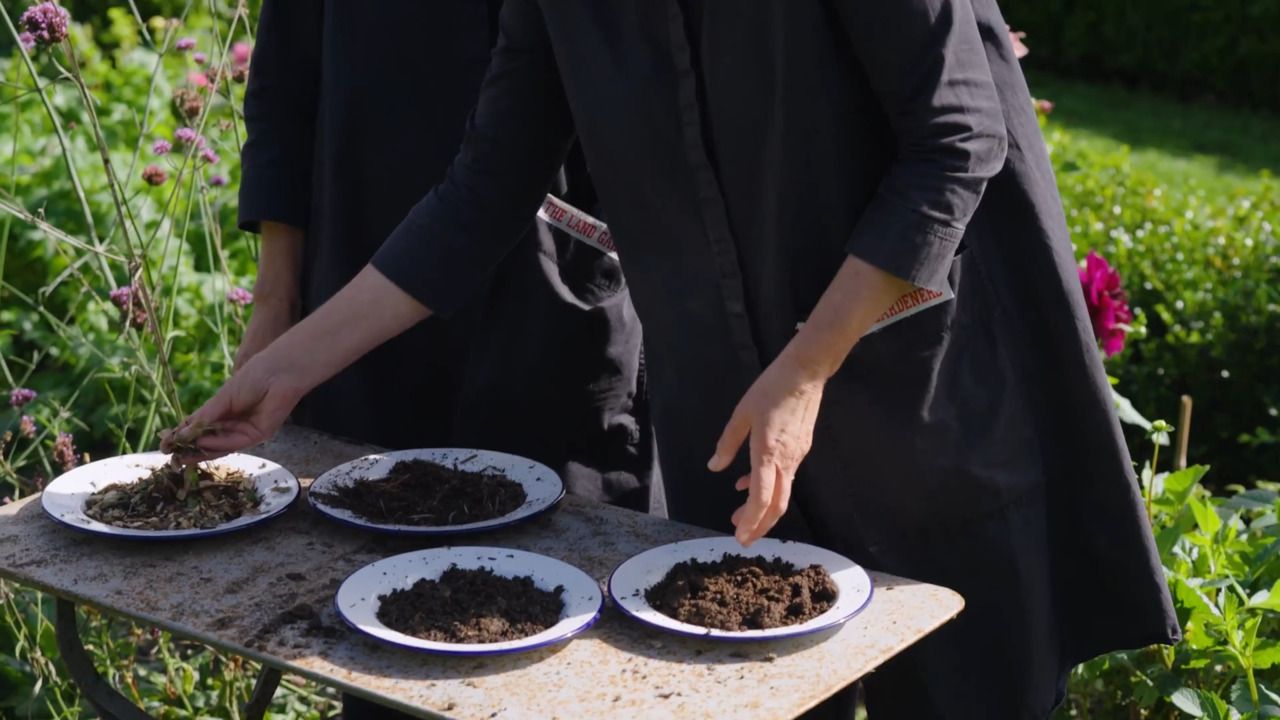
A nutrient-rich soil will contain a good amount of humus. Humus is naturally decayed organic material which has been broken down by soil microbes. Organic materials that are still in the process of breaking down are called compost, whereas humus is the final product.
In healthy soils, you'll find a good amount of humus in the topsoil. Humus helps the soil to retain moisture in times of drought and has a crumbly, friable texture. The colour will be a dark, chocolatey brown and it will smell earthy and nutty.
Humus is rich in nutrients too and is key to growing strong, vigorous plants.
Get the full workbook, video lessons, and more with a Create Academy subscription.
Subscribe to access the full workbookAlready a member? Sign in to watch
491 reviews
Read moreCreate Academy has been such a great resource. I'm in the middle of renovating a bungalow with a very large garden and the courses have offered a wealth of inform...
Harvey
Jun 10, 2026
Absolutely love Create Academy! The instructors are extremely informative, and it is beautifully filmed. Create Academy is great value for money and plan on renew...
SG
May 31, 2026
Butter's creativity is stunning! Her ability to incorporate brilliance in small gardens is magical!
Carla
May 30, 2026
The best adventure. I like all the courses, but my favorite are both Rita Konig interior design courses and Anna Jones. Excellent!
Karolina Kluczewska
May 20, 2026
Create Academy has been such a great resource. I'm in the middle of renovating a bungalow with a very large garden and the courses have offered a wealth of information to dive into and explore new ideas. I'm...
Harvey
Jun 10, 2026
Absolutely love Create Academy! The instructors are extremely informative, and it is beautifully filmed. Create Academy is great value for money and plan on renewing my subscription yearly because there are ...
SG
May 31, 2026
Butter's creativity is stunning! Her ability to incorporate brilliance in small gardens is magical!
Carla
May 30, 2026

Your Instructor
Award-winning garden designers and cut flower growers on a mission to save our soil.
Garden designers, flower growers and compost creators, Henrietta Courtauld and Bridget Elworthy joined forces to found The Land Gardeners in 2012. United by their passion for organically grown plants and a shared interest in soil health, they began by growing and selling cut flowers to esteemed florists, and worked on restoring historic gardens to their former glory. Most recently, they launched Climate Compost - a project born from years of inquisitive research into soil biology with the aim of creating a microbially rich compost that produces nutrient dense crops, while also supporting and boosting the local ecosystem. With an unwavering commitment to improving the health of our land and its biodiversity, The Land Gardeners’ approach is one of sensitivity, unparalleled expertise and, above all, a loving respect for the natural world and its preservation.
Access to all courses


.jpg)