







Interior and exterior confidence
Create Academy has been such a great resource. I'm in the middle of renovating a bungalow with a very large garden and the courses have offered a wealth of inform...
Harvey
Jun 10, 2026
An Expert Guide to Planting Design
with DAN PEARSON — Acclaimed naturalistic landscape designer. Multiple Chelsea Gold Medal Winner. OBE.
Lesson 20 of 31

Subscribe to watch
Dan discusses choosing plants for shade and designing a planting that oozes calm and tranquillity, whilst providing year-round interest and making optimal use of a small space. You’ll learn to see shade not as a limitation, but as an opportunity.
Shade shouldn't be seen as a limitation, but rather as an opportunity. In this lesson, I'll explore how I chose plants for these conditions and designed the planting to create a tranquil atmosphere, whilst providing year-round interest and making best use of the small space.
Although I was inspired by British woodlands for this garden, the majority of the plants I've used are ornamentals derived from woodland plants around the world, which have then been selected for their garden worthiness, although all share an ability to thrive in these conditions.
By opening up to the full choice of ornamental plants, we can access a great range of complementary elements, which when composed carefully, can all work together to produce a whole that feels right.
As we have a cool, north-facing site, I've chosen things that are all adapted to this environment. However, this shouldn't be seen as a restriction; rather, it's an opportunity to create a garden full of plants that really love these conditions. Since you're working with the environment and not against it, the plants will automatically thrive.
Looking at a natural woodland, you'll find layering, from trees, to shrubs, to perennial layers ranging from emergents to ground covers, to spring bulbs. We've essentially echoed that in this garden:
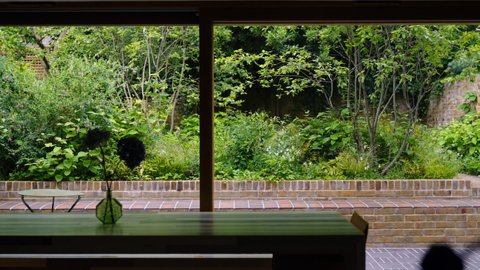
The garden has to work not just when you come into it, but also as a backdrop when looking out from the window. These layers of greens all work together so you don't quite know where the garden begins or ends, and from inside it feels much bigger than it is.
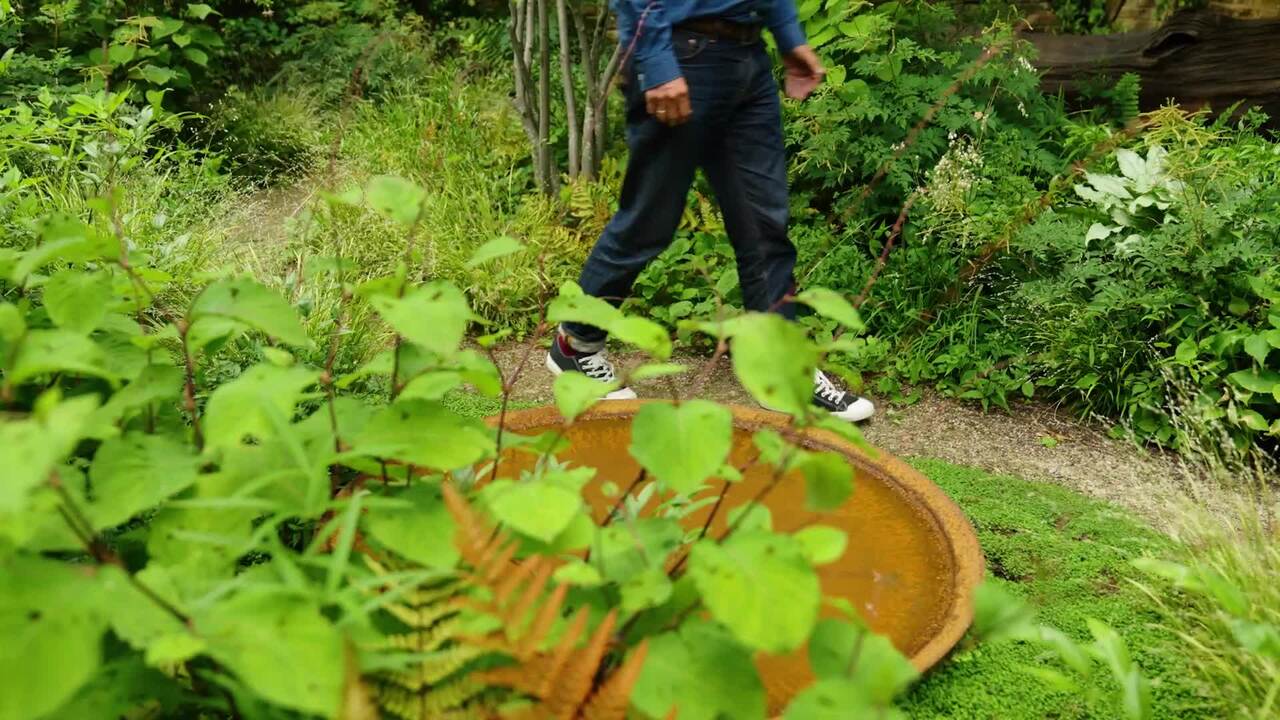
Once you come into the garden, we've created a sense of journey:
This simple loop from one side of the garden to the other, with a pausing space where you re-orientate your view, means that on arriving back at the terrace, you feel you've been on a journey.
The bay tree is a big driver of the mood of this garden. We're also borrowing the neighbour's Magnolia grandiflora. These are both very particular greens, and give the garden a certain weight and mood.
I keyed into these drivers to bring those greens further out into the garden. I chose the following plants to work with them:
As a contrast to the evergreens, I wanted to make sure we were inviting all the four seasons into the garden. Therefore, the next thing we looked at were plants that can provide year-round structure:
After the climbers, the next thing I put in were the two Amelanchier trees. These work well all year round, from spring blossom to magnificent autumn colour, and in between, an airy canopy of foliage in an easy shade of green that works well with other plants and contrasts with the evergreens behind.
Then we worked down into the shrubs. As this is only a small space, I haven't used many. I've used mostly deciduous shrubs, which complement the Amelanchier and create seasonality in the open areas.
I've used very few evergreen shrubs, as we're borrowing evergreens from outside the garden, but also because they can eat a space up, and don't allow things to grow underneath them easily. I've just used two groups of evergreen shrubs to buffer the rear corners, essentially to stop the garden feeling like a box.
If you're working with a small space, it's very useful to think about the scale of the foliage.
Here, in this rear garden, which is only 10 x 8 m, I've used predominantly delicate, small-leafed plants that help the space feel larger than it is, because your eyes aren't alighting on large foliage.
By using leaf forms and textures that work nicely against each other, you create a tapestry of greens that is always interesting, even when the flowers aren't there to ornament the greens.
The perennials create seasonal change in the garden. When assembling a plant list, make sure to include perennials that provide interest right from the start of the growing season, through to the very end, and perhaps onwards through winter if you can leave the skeletal forms.
In this shady rear garden, some of the key players in the perennial layer include:
As we've seen, it's always worth considering the layering, and the layers within layers, when putting a planting together. I think about the layering of perennials in much the same way as I think about the layering of trees and shrubs: you've got the high canopy, the mid canopy and the low canopy.
An example of a perennial layering system here in the shady rear garden is:
So layering starts below ground with the bulbs, through to the ground cover at ground level, to the mingling of the mid layer and the emergents, to the shrubs, the small trees, and beyond that to the taller trees.
Planting is very much a layered exercise and by carefully considering the layering, you can provide as much interest as possible in a small space.
Bulbs provide interest early in the year. They work in harmony with the perennials by providing fresh early season foliage, and later dropping away as the perennials come through.
I've chosen bulbs which have a long lifetime – snowdrops for example come back every year. I haven't used short-lived bulbs like ornamental tulips.
The bulbs are designed to be a reliable and enduring layer, which can provide a long season of interest throughout the first half of the year before retreating as the perennials come up around them.
Amelanchier lamarckii
Magnolia grandiflora
Trachelospermum asiaticum
Parthenocissus 'Henryana'
Schizophragma integrifolia
Mahonia eurybracteata
Magnolia wilsonii
Fuchsia magellanica var. molineae
Sarcococca hookeriana
Persicaria virginiana
Melica altissima 'Alba'
Pulmonaria
Eurybia divaricata
Fragaria vesca
Soleirolia soleirolii
Galanthus
Nectroscordum siculum (aka Allium siculum)
Get the full workbook, video lessons, and more with a Create Academy subscription.
Subscribe to access the full workbookAlready a member? Sign in to watch
491 reviews
Read moreCreate Academy has been such a great resource. I'm in the middle of renovating a bungalow with a very large garden and the courses have offered a wealth of inform...
Harvey
Jun 10, 2026
Absolutely love Create Academy! The instructors are extremely informative, and it is beautifully filmed. Create Academy is great value for money and plan on renew...
SG
May 31, 2026
Butter's creativity is stunning! Her ability to incorporate brilliance in small gardens is magical!
Carla
May 30, 2026
The best adventure. I like all the courses, but my favorite are both Rita Konig interior design courses and Anna Jones. Excellent!
Karolina Kluczewska
May 20, 2026
Create Academy has been such a great resource. I'm in the middle of renovating a bungalow with a very large garden and the courses have offered a wealth of information to dive into and explore new ideas. I'm...
Harvey
Jun 10, 2026
Absolutely love Create Academy! The instructors are extremely informative, and it is beautifully filmed. Create Academy is great value for money and plan on renewing my subscription yearly because there are ...
SG
May 31, 2026
Butter's creativity is stunning! Her ability to incorporate brilliance in small gardens is magical!
Carla
May 30, 2026

Your Instructor
Acclaimed naturalistic landscape designer. Multiple Chelsea Gold Medal Winner. OBE.
British landscape designer, horticulturalist and writer Dan Pearson OBE, has been designing award-winning gardens since 1987. His naturalistic use of plants, light-handed approach to design and deep-rooted horticultural knowledge has made him one of the most celebrated and innovative gardeners working today. Dan trained in horticulture at Wisley and Kew, before starting his garden and landscape design practice in 1987. In 2015, his show garden for Chatsworth and Laurent Perrier was awarded a Gold Medal and Best Show Garden at the Chelsea Flower Show. In 2014 Dan was appointed an advisor to the National Trust at Sissinghurst Castle. For over 20 years Dan has written regular gardening columns, with his work a staple of The Observer, and has written a number of best-selling gardening books.
Access to all courses


